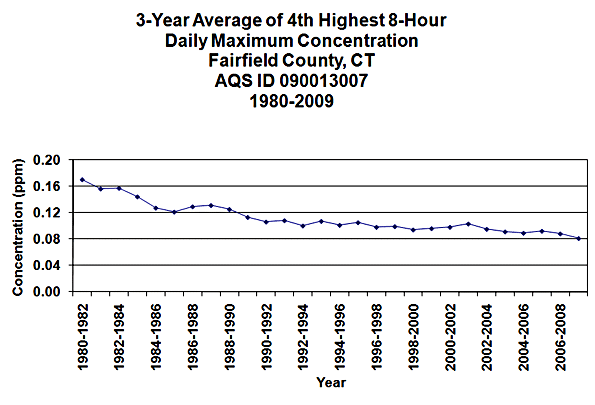
The figure above illustrates the slowing
down process for Fairfield County, Connecticut. Note the rapid
decrease in the early years and then a "flattening"
of the curve in the later years. When
one compares the Fairfield County figure with the results described
in EPA's latest trends report, the similarities are observed.
The slight downward pattern observed for the periods 2002-2004,
2003-2005, and 2004-2006 is a result of the 0.081 ppm 4th highest
annual 8-hour average value experienced in 2004.
The year-by-year
figure below illustrates the changes in the 4th highest daily
maximum concentration. A rapid decrease in the early years occurred,
but less of a decline occurred in the later years. For this monitoring
site, a weaker statistically significant downward trend was observed
for the 1990-2005 period than for the 1980-2005 period (-1.01
%/year versus -1.95 %/year, respectively) (Lefohn, et al., 2008).
The 0.081 ppm value
that occurred in 2004 is the second lowest 4th highest annual
8-hour average value recorded between 1980 and 2007. The 4th
highest values recorded in the years 2005 and 2006 were 0.090
and 0.095 ppm, respectively. The effect of the 0.081 ppm value
was to depress the 3-year average of the 4th highest 8-hour concentration
for the 2004-2006 period. As noted in the previous figure, the
4th highest 8-hour average increased from 0.089 for the 2004-2006
period to 0.092 for the 2005-2007 period. The elimination of
the 2004 contribution of the 0.081 ppm value (as a result of
including only the years 2005, 2006, and 2007), resulted in a
higher 3-year average for the 4th highest 8-hour concentration
for the 2005-2007 period.
Reference
Lefohn A. S.; Shadwick D.; Oltmans S. J.
(2008). Characterizing long-term changes in surface ozone levels
in the United States (1980-2005). Atmospheric Environment. 42:8252-8262.