A Very Important
Component in the Setting of Ozone Standards
During past rulemaking activities that
reviewed the current ozone human health and vegetation standards,
the US EPA appeared to be mainly focused on estimating how much
of current O3 levels can be attributed to sources other than
U.S. anthropogenic sources on days when ambient levels exceeded
the O3 national standards. While this consideration may be important,
background O3 also plays an important role in influencing human
health effects risk assessments. The human health risk and exposure
assessments play an important role in the margin of safety determinations
intended to address uncertainties associated with inconclusive
scientific and technical information available at the time of
the standard-setting determinations. The margin of safety determination
is also intended to provide a reasonable degree of protection
against hazards that research has not yet identified. Background
O3 concentrations in the low- and mid-level parts of the distribution
of ambient concentrations make up a large fraction of the total
O3 levels and potentially can influence those human health risk
assessments associated with the margin of safety determinations
for the setting of the primary (human health) O3 NAAQS.
Background ozone in the US, which includes
both natural, as well as long-range transport from sources in
Asia, is a major issue. However, it is not just a consideration
in the US but also a consideration worldwide when considering
attaining air pollution standards. At times (1) background ozone
is greatly associated with the high concentrations experienced
in the US Intermountain West (Lefohn et al., 2001; Langford et
al., 2009; McDonald-Buller et al., 2011; Jaffe et al., 2018;
Mathur et al., 2022) that affect attainability of ozone air quality
standards and at other times (2) background ozone contributes
on a continuous basis to observed concentrations that influence
human health and vegetation risk estimates. In both cases, background
ozone influences the recommended levels for ozone standards.
With the appropriate understanding of the relative importance
of background ozone and how it contributes to observed ozone
levels, its place in the decisionmaking process for assessing
(1) human health and welfare risks, (2) attainability of ozone
standards, and (3) benefits accrued from emission reductions
can better be placed into perspective. In December 2015, the
EPA issued a white paper to establish a common understanding
and foundation for additional conversations on background ozone
and to inform any further action taken by the Agency. The paper
described several modeling studies that attempted to estimate
background ozone levels by assessing the remaining ozone in a
model simulation in which certain emissions were removed. This
basic approach, which is often referred to as “zero-out”
modeling (i.e., U.S. manmade emissions are removed) or “emissions
perturbation” modeling, has been used to estimate background
ozone levels. Another modeling technique, referred to as “source
apportionment” modeling, can also be used to estimate the
sources that contribute to modeled ozone concentrations (please
see Lefohn et al., 2014 and Dolwick et al., 2015 as examples).
This approach estimates the contribution of certain source categories
(e.g., natural sources, non-U.S. manmade sources) to modeled
ozone at each model grid cell on an hourly basis. The "source
apportionment" modeling approach is the one used in Lefohn
et al. (2014) because the authors believed it was more appropriate
to use the approach to answer the question "what percentage
of the actually observed ambient ozone hourly average (or 8-h
average) concentration was associated with background?"
Besides calculating background 8-h average concentrations for
the human health ozone standard, 1-h average background concentrations
are important for determining the relative importance of background
to anthropogic contributions for determining W126 exposure values for protecting vegetation.
In the mid-1800s, surface ozone was the
focus of many scientific studies to prove its existence, to discover
its functions in the atmosphere, and to define its role in affecting
the spread of epidemics. Ozone was commonly measured using the
Schoenbein ozonoscope method. Schoenbein papers were coated with
iodide; the reaction with ozone formed iodine. Ozone concentration
was expressed as Schoenbein numbers based on coloration of Schoenbein's
test paper. Gases other than ozone influenced the test paper.
Observers were cautioned to expose the paper away from possible
sources of sulfuric acid. In addition, the coloration tests were
affected by atmospheric humidity, air flow, other oxidants, and
accidental exposure to direct sunlight.
Despite the method's limitations, starting
in the mid-1800s, more than 300 stations recorded ozone exposures
in countries such as Austria, Australia, Belgium, England, France,
Germany, Russia, and the United States. Only a few stations observed
ozone continuously for more than a few years and only data summaries
exist. Based on data evaluated, some scientists have concluded
that (1) the annual average daily maximum of the surface
ozone partial pressure in the Great Lakes area of North America
was approximately 0.019 ppm, and (2) the annual average
of the European measurements between the 1850s and 1900 were
mostly in the range of approximately 0.017 ppm to 0.023 ppm.
The authors concluded that these values were approximately half
of the mean of the daily maximum of the observations observed
during the last 10-15 years in the same geographical regions.
Some scientists have stressed that the
estimated ozone concentrations, using the Schoenbein method,
should be regarded as approximate rather than absolute. Some
have also cautioned that many uncertainties exist when attempting
to relate data collected by the Schoenbein method with absolute
ozone concentrations. They pointed out that because of relative
humidity variation among different monitoring sites, a comparison
of Schoenbein values may be invalid.
During the second half of the nineteenth
century, precise methods for measuring ozone were not easily
available. During this period, one of the only laboratories that
made quantitative measurements of surface ozone was the Paris
Municipal Observatory, located in Park Montsouris. Beginning
in 1876 and continuing for 31 years, daily measurements were
carried out. Ozone was related to the amount of arsenite converted
to arsenate, which was measured by titration with an iodine solution.
Details of the method and data were published in the monthly
and annual bulletins of the Observatory. The method has a positive
interference when H2O2 and NO2 are present and a negative interference
when SO2 is present.
Based on a review of the data obtained
using this method, it was reported that the annual monthly
maximum at Montsouris occurred in the May-June time period,
which is a similar time period observed for maximum 8-hour average
concentrations observed for some sites experiencing reduced emissions
today. The annual monthly minimum occurred in November. It was
reported that the average concentration for 31 years, starting
in 1876, was approximately 0.014 ppm and showed a tendency to
increase. Further, it was also reported, using the ozone data
collected at Montsouris between 1876 and 1910, that the annual
average ranged from 0.005 to 0.016 ppm, with the average over
the entire period being 0.011 ppm.
The quality of the ozone data collected
at Montsouris, as well as other locations in the late 1800s and
early 1900s, is unclear. Therefore, any comparison of absolute-value
concentrations, inferred from measurements during this period,
with current concentrations at "clean" sites should
be done with great caution. While the uncertainty of the absolute
concentrations is an important consideration, it is important
to point out that the observation that annual maximum concentrations
occurred during the springtime is an important piece of information.
The springtime maximum concentrations may be associated with
natural sources of stratospheric ozone that is influencing surface
ozone concentrations during this period of the year (Lefohn et
al., 2001; Langford et al., 2009; Lefohn et al., 2011; Lefohn
et al., 2012; Lefohn et al., 2014; Škerlak et al., 2014,
2019). In addition, it is unknown to what extent the Montsouris
data represent ozone concentrations in Europe or the Northern
Hemisphere. It is clear that the monthly average surface ozone
concentrations in the last half of the nineteenth century appear
to be lower than those currently measured at many rural locations
in the eastern United States and Europe. For example, the annual
average concentrations estimated for Montsouris were much lower
than those calculated for 1980-1987 for the South Pole and Point
Barrow (Alaska). However, when reviewing the data, the evidence
is not conclusive that the surface ozone concentrations measured
in the last half of the nineteenth century at certain locations
in either Europe or North America are approximately 50% of those
currently monitored at "clean" rural locations. An
article on the limitations of using the Schoenbein method to
estimate absolute historic ozone concentrations was published
in early 1999 in the peer-reviewed journal, Atmospheric Environment.
One alternative approach
that has been used is to identify a range of ozone exposures
that occur at "clean" sites in the world. Some of the
percentile distributions of the hourly
average concentrations for some of these clean sites can be viewed.
In addition, the percentile of hourly average concentrations
for sites that experience low maximum hourly average concentrations
over the April - October period can be observed by clicking
here.
Note that the maximum hourly average concentrations
at some of the most pristine sites in the world today are higher
than the low levels observed over 100 years ago. Some scientists
have suggested that ozone is now increasing everywhere by at
least 1% per year. Does that mean that every place in the world
today is affected by human-induced activities or are the numbers
estimated from the old measurements not reliable? Papers by Oltmans
et al. (1998, 2006, 2013), which were published in peer-reviewed
journals, report that surface ozone is not increasing
in the world at 1% per year. At many monitoring sites, surface
ozone is not increasing at all (Lefohn et al., 2017). You can
find the full citation to these papers in the Publications
section of this website.
Prior to 2006, ozone measurements from
remote monitoring sites were used to estimate background. EPA
(1996) estimated hourly average summer background concentrations
of 30-50 ppb and applied a background of 40 ppb in its risk analyses.
EPA (2006) cited the work of Fiore et al. (2002, 2003), who applied
the GEOS-Chem global model to estimate a mean background concentration
range of 15-35 ppb. At that time, EPA (2006) defined North American
background (NAB) ozone to include contributions from global anthropogenic
and natural sources in the absence of North American (i.e., U.S.,
Canada, and Mexico) anthropogenic emissions. The level of NAB
defined that concentration or range of concentrations that EPA
believed would be experienced if the United States and other
countries in North America were to initiate a zero emissions
strategy. In other words, the NAB concentrations define the level
below which ozone standards could not be set. In 2023, EPA (2013)
defined US background (USB) ozone concentrations to include anthropogenic
contributions from Canada and Mexico. In 2014, Lefohn et al.
(2014), as well as the EPA (2014), introduced the concept of
source-apportionment based background ozone. Emissions-influenced-background
(EIB) ozone, as introduced by Lefohn et al. (2014), which is
almost identical to source-apportionment US Background conditions
as defined by the EPA, reflects background concentrations under
current emissions-influenced conditions. In urban areas, EIB
is chemically decayed but it converges upward toward the higher
NAB metric as anthropogenic emissions are reduced in North America.
EIB ozone provides policymakers an indication of current background
levels and how much improvement might occur if anthropogenic
emissions were reduced at a specific location. While some scientists
argue that long-range transport from Asia dominates background
ozone concentrations, other scientists believe that natural processes,
such as stratospheric intrusions dominate background ozone concentrations
across the U.S. This is an important area of science that requires
further investigation because answers resulting from this area
of science provide to policymakers how much reduction in background
ozone concentrations might occur if emissions were to be reduced
in Asia. If natural stratospheric intrusions are responsible
for replenishing background ozone levels more than long-range
transport effects on background ozone, then reductions in background
ozone levels might not be as significant as some think if Asian
emissions were greatly reduced. A.S.L. & Associates continues
its efforts to investigate the importance of the contribution
to background ozone from natural stratospheric sources.
As a result of its subjective definition
of background, the U.S. EPA has questioned the use of remote
monitoring sites in the world as a reasonable way to establish
limits on natural ozone exposures in today's world. Based on
its definition, EPA concluded initially that NAB could only be
estimated using chemical transport models (CTMs). However, scientists
(e.g., McDonald-Buller et al., 2011) believed that empirical
data at a monitoring site at Trinidad Head, CA allowed for the
characterization of NAB.
Although acknowledging EPA's desire to
use a model to estimate NAB, the EPA's Clean Air Scientific Advisory
Committee (CASAC) in August 2006 concluded that there was a large
degree of uncertainty associated with the estimates of NAB using
the model. EPA (2007) acknowledged that the monitoring site at
Trinidad Head, CA provides information about NAB concentrations
of ozone. Oltmans et al. (2008) described the ozone exposures
occurring at the Trinidad Head (CA) monitoring site. It appears
based on the results published by Oltmans et al. (2008) that
the chemical transport model that EPA used for its NAB estimates
for risk assessments for ozone was unable to account for the
numerous occurrences of hourly average NAB concentrations greater
than or equal to 0.05 ppm measured. The percentile
distribution of the hourly average concentrations and the
top 10 8-hour average daily maximum concentrations
for Trinidad Head are available for review.
Since 1985, A.S.L. & Associates has
performed research on identifying background ozone levels. We
were asked to "identify natural background ozone" in
the early 1980s for the U.S. EPA, as well as for the National
Acid Precipitation Assessment Program (NAPAP). State of Science
Report Number 7 for NAPAP summarized our results and we published
our findings in the peer-review literature (please see publication
list).
In July 1999, a
Harvard University research group published a peer-reviewed paper
(Geophysical Research Letters 26:2175-2178) that predicted
that the long-range transport of ozone from Asia would increase
background ozone levels in the western and eastern U.S. The papers
by Oltmans et al. (1998, 2006, 2013) did not indicate
that ozone was increasing at the cleanest sites in the world
for previous years. In addition, using a moving 15-year trends
analysis, Lefohn et al. (2010) and Oltmans et al. (2013) indicated
that ozone trends at sites in the western U.S. did not appear
to illustrate current increases in surface ozone levels and that
in some cases, earlier trend patterns that showed increases were
no longer showing such patterns. However, other researchers (e.g.,
please see papers cited in Cooper et al., 2012) indicate that
long-range transport from Asia is enhancing ozone concentrations
in the western US and these enhancements may be responsible for
observed increasing trends at some western US monitoring sites,
as well as possibly other locations across the US. Lin et al.
(2012), using the AM3 model, estimated that western US spring
and early summer background ozone is routinely elevated by stratospheric
ozone with STT-S contributing more than ozone generated from
Asian emissions. Similar findings were reported by Ambrose et
al. (2011) for the Mount Bachelor area in Oregon. The modeling
results reported in Lefohn et al. (2014) support the Lin et al.
(2012) findings. For areas east of the Intermountain West, Lin
et al. (2012) reported that Asian emissions had minimal impact.
This is an important observation that will be addressed in future
discussions concerning background ozone.
For over 40 years,
we have had an on-going research effort to better understand
the range and frequency of occurrence of background ozone levels
that may not be affected by emission reduction strategies. In
2001, we published a peer-reviewed paper
authored by the research team of Allen Lefohn, Samuel Oltmans,
Tom Dann, and Hanwant Singh. Our 2001 paper was possibly one
of the first to point out that the stratosphere was contributing
at times to natural violations of the 8-h ozone standard. Langford
et al. (2009) have also reported on the importance of the stratosphere
in resulting in violations of the 8-h ozone standard. In our
2001 paper, we analyzed hourly average ozone concentrations greater
than or equal to 0.05 ppm and 0.06 ppm that were experienced
during the photochemically quiescent months in the winter and
spring at several rural sites across southern Canada, the northern
United States, and northern Europe. Our results were mostly consistent
and indicated that hourly average ozone concentrations greater
than or equal to 0.05 ppm and 0.06 ppm occurred frequently during
the winter and spring months. Most occurrences were during April
and May but sometimes as late as June. In some, but not all,
of the cases that were studied, a plausible explanation for the
higher ozone values was the presence of upper tropospheric and
stratospheric air that was transported down to the surface. The
ozone monitoring sites investigated in the US were Denali National
Park (Alaska), Yellowstone National Park (Wyoming), Glacier National
Park (Montana), and Voyageurs National Park (Minnesota). In the
paper, we noted that the relative contribution of the stratosphere
to tropospheric ozone is important because policymakers have
promulgated surface ozone standards in the United States and
Canada at such levels that exceedances might occur as a result
of episodic, naturally occurring events that cannot be significantly
altered by implementing emission reduction strategies. Although
modeling results have been published questioning our conclusions
(e.g., Fiore et al., 2003) about the importance of stratospheric
ozone in affecting surface-level ozone concentrations, we believe
that there are limitations to the models to adequately quantify
the importance of stratospheric-tropospheric exchange (STE) processes
that result in enhanced ozone concentrations occurring during
the spring months across the US. Lefohn et al. (2014) used an
adjusted GEOS-Chem model to estimate background ozone. We reported
that one has to adjust background estimates from the GEOS-Chem
model to provide a more realistic estimate of background ozone.
Our research results (Lefohn et al., 2011, 2012, 2014) continue
to support our previous conclusions (Lefohn et al., 2001) about
the importance of natural stratospheric-tropospheric exchange
processes in affecting surface ozone concentrations at both high-
and low-elevation monitoring sites across the US.
At western high-elevation
sites, the contributions of daily background to total ozone are
usually greater than 70% over the entire year (Lefohn et al.,
2014). Estimates for high-elevation sites by Dolwick et al. (2015)
for the April-October 2007 period agree with estimates by Lefohn
et al. (2014). For many of the low-elevation sites across the
US, the contributions of background are 50% and higher during
non-summer months. Dolwick et al. (2015) report that for low-elevation
sites in the western US, background ozone consists of 40-60%
for the top 10% of observed 8-hour daily maximum concentration
values. In some cases, the contribution is greater than this
range for the low-elevation sites.
An Internet-based
slide presentation is available for purposes
of previewing our original 2001 paper. Also please be sure to
check out the answer to our quiz
that identifies the month in which the highest 8-hour daily maximum
concentration occurred for the 4 remote ozone monitoring sites.
Additional information on background ozone can be found in the
Air Quality Analyses section of the Table
of Contents.
Lefohn et al. (2014)
have characterized the percent contribution from background ozone
to the total ozone observed at the Yellowstone National Park
site in Wyoming, as well as 22 other locations across the US.
The authors reported that the contribution of background ozone
at the site in Wyoming was very large (i.e., generally greater
than 80-90% of the total surface ozone). The highest ozone concentrations
at the site appeared to be associated with stratospheric intrusions.
There are several
physical processes at work that are helping to define the distribution
of naturally occurring ozone concentrations. All of these processes,
plus some important chemical processes, are affecting the ability
of the US and Canada to attain their 8-hour ozone standards.
At ozone monitoring sites where the maximum
hourly average concentration experienced is low in the United
States (i.e., relatively remote, clean monitoring sites), the
8-h daily maximum ozone concentration is near the 0.070 ppm level.
These clean, rural sites are discussed in Chapter 3 of the Ozone
Criteria Document. In the previous version of the Criteria Document,
the distribution of the hourly average concentrations for the
clean sites was presented in Tables 4-6 and 4-7. An Adobe
PDF file can be downloaded to review some of these values. Note the hourly maximum concentrations
at these sites are well above the EPA's defined 0.040 ppm level
which was previously assumed for natural background.
Review the top 10 8-hr average daily maximum concentrations,
which are derived from data measured at these clean sites. In
1999, the 8-hr daily maximum concentration at Yellowstone National
Park in Wyoming was 0.078 ppm. This "episode" occurred
on March 25th. 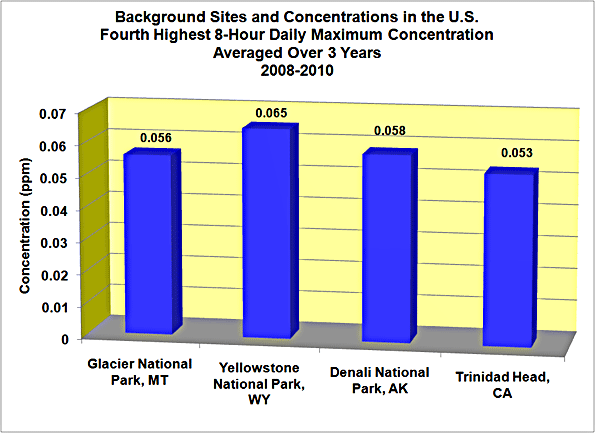 This
is a period when photochemically produced ozone is much less
important than during the summer months. Other processes are
at work, such as natural stratospheric contributions. The figure
to the right summarizes the 4th highest 8-hour average daily
maximum concentration
averaged over 3 years for 2008-2010. A larger view of the figure
is available. The 3-year averages of the
fourth highest 8-hr daily maximum concentrations at these sites
are much higher than the EPA's assumption of ozone background
values in the range of 0.015 to 0.035 ppm. The 8-hour daily maximum
values above 0.040 ppm are not rare, but are very common and
in many cases represent background ozone. For many of the clean
sites, more than 50% of the 8-hour daily maximum concentrations
are above 0.040 ppm. The EPA estimate of background of 0.015
ppm to 0.035 ppm is too low and the simulation models used to
predict background levels underestimate the importance of natural
processes.
This
is a period when photochemically produced ozone is much less
important than during the summer months. Other processes are
at work, such as natural stratospheric contributions. The figure
to the right summarizes the 4th highest 8-hour average daily
maximum concentration
averaged over 3 years for 2008-2010. A larger view of the figure
is available. The 3-year averages of the
fourth highest 8-hr daily maximum concentrations at these sites
are much higher than the EPA's assumption of ozone background
values in the range of 0.015 to 0.035 ppm. The 8-hour daily maximum
values above 0.040 ppm are not rare, but are very common and
in many cases represent background ozone. For many of the clean
sites, more than 50% of the 8-hour daily maximum concentrations
are above 0.040 ppm. The EPA estimate of background of 0.015
ppm to 0.035 ppm is too low and the simulation models used to
predict background levels underestimate the importance of natural
processes.
In an interesting attempt
to identify background sites, the OTAG Air Quality Analysis Work
group estimated background levels by selecting sites in rural
areas in the corners of the OTAG region. The arithmetic mean
of the daily maximum 1-hour concentrations for the "background"
sites can be seen by clicking here.
Note that the long-term arithmetic means of the daily maximum
1-hour concentrations are in the 30-50 ppb range. However, it
is important to explore the range of values for the 8-hour daily
maximum concentrations by clicking here.
Note that the top 8-hour daily maximums for the OTAG "background"
sites are in the 59 to 90 ppb range. This range is much higher
than EPA estimates for natural background levels. If the OTAG
sites are actually "background" sites and the 8-hour
daily maximum concentrations, in some cases, are so close to
the 8-hour ozone standard, how can the standard be attained?
On the other hand, perhaps most of the "background"
sites identified by OTAG are not background.
There is a substantial
background of ozone present in the lower troposphere in the Northern
Hemisphere that has a stratospheric origin. As indicated above,
there has been considerable discussions over the past several
years on the importance of stratospheric ozone in contributing
to surface ozone concentrations. Models (e.g., GEOS-CHEM) have
been exercised and appear to illustrate that stratospheric ozone
is not important for enhancing background ozone monitoring sites
except for infrequent exceptional high concentrations. However,
Lin et al. (2012) indicate that the AM3 model is able to illustrate
the importance of stratospheric ozone affecting surface level
ozone concentrations. Hu et al. (2017) have conducted a comprehensive
evaluation of the standard version of GEOS-Chem (v10-01) with
ozone observations from ozonesondes, the OMI satellite instrument,
and MOZAIC-IAGOS commercial aircraft for 2012-2013. The authors
reported that the most pronounced model bias was at high northern
latitudes in winter-spring, where the model was 10-20 ppb too
low. The authors attributed the bias in the model to insufficient
stratosphere-troposphere exchange (STE). Empirical evidence shows
that stratospheric contributions to surface ozone is important
(Lefohn et al., 2001; Cooper et al., 2005; see
Lefohn et al., 2014 for additional references) at both high-
and low-elevation sites. Chemical transport models, such as GEOS-CHEM,
have great uncertainty associated with their predictions and
are not able to successfully reproduce the temporal changes in
hour-by-hour concentrations (Goldstein et al., 2004).
The EPA's 2006 criteria document on ozone (EPA, 2006) and Integrated
Science Assessment (EPA, 2013) summarize some of the concerns
in using chemical transport models, such as the GEOS-CHEM model,
to estimate ozone background levels.
In September 2009, the
National Research Council released the report, Global Sources
of Local Pollution. In the report, the Committee stated that
modeling and analysis supported the finding that background ozone
is 20-40 ppb for the United States. The NRC report noted that
the discussion by Lefohn, Oltmans, Dann, and Singh (2001) that
occurrences of hourly average concentrations associated with
background ozone are higher than the level indicated in the NRC
report and that the NRC hypothesized that the levels reported
by Lefohn et al. (2001) were associated either with high-elevation
sites or with more distant North American pollution. The conclusions
in the NRC report were unfortunately inaccurate. Since we published
the Lefohn et al. (2001) paper, evidence has been published in
the peer-review literature indicating the importance of stratospheric
ozone in enhancing observed ozone surface concentrations at both
high- and low-elevation monitoring sites. As indicated above,
we believe the GEOS-Chem model did not adequately handle the
stratosphere and that it is possible to adjust the GEOS-Chem
model to obtain a much better estimate of background ozone (please
see Lefohn et al., 2014). In addition, our research on background
ozone, using empirical data, indicates that levels are higher
than 20-40 ppb in the United States. One of our research papers
on background ozone (Oltmans et al., 2010) discusses the importance
of Eurasian biomass burning and how it influences background
ozone concentrations in the US. Our research is continuing on
this matter and current results published in the peer-review
literature support our previous conclusions that hourly levels
greater than or equal to 50 ppb occur more frequently as a result
from natural sources than models suggest. The enhanced hourly
average concentrations influenced by background ozone also result
in enhanced 8-h average concentrations that are used in the ozone
standard-setting process. At many high-elevation sites, much
of this enhancement is due to naturally occurring stratospheric
ozone influencing ground-level ozone. Since our 2001 paper, many
more peer-reviewed research papers continue to be published that
support our earlier conclusions.
Besides the importance
of the natural contribution from the stratosphere to surface
ozone concentrations, because of its increased frequency, wildfires
in the United States and Canada are becoming a very important
contributor to enhanced levels of surface ozone exposures. In
the EPA's definition of natural background, sources of US background
ozone include naturally occurring emissions, such as wildfires,
biogenic volatile organic compounds (VOCs), oxides of nitrogen
(NOx ) from soil, lightning NOx, stratosphere-to-troposphere
exchange, and oxidation of methane (Skipper et al., 2024). Skipper
et al. (2024) note that some portions of total ozone contributions
from soil NOx and methane oxidation are US background sources,
while some are anthropogenic. Simon et al. (2024) note that wildfires
burned a record number of acres in Canada during the spring and
summer of 2023. The authors noted that smoke plumes from these
fires impacted locations across the United States and led to
an unusual number of fire-impacted pollution episodes in some
areas. In the United States, states and local agencies may exclude
certain high-pollution days from regulatory determinations if
they can demonstrate, among other points, that a clear causal
relationship exists between ozone and an event that is not reasonably
controllable or preventable, such as a wildfire. In 2023, fire
emissions from Canada, mixed with other natural and anthropogenic
US emissions, made it challenging to quantify the portion of
ozone that originated from the fire plumes without sophisticated
modeling tools. Simon et al. (2024) described a screening-level
modeling dataset to show how existing datasets can be utilized
to produce rapid estimates of fire impacts on ozone.
It is important that the range of background
hourly average concentrations is correctly characterized. The
inadequate characterization of background ozone at both low-
and high-elevation sites will lead to 1) inflated human health
risk estimates and 2) overly optimistic policy expectations on
the levels to which hourly average ozone concentrations can be
lowered as a result of emission reduction requirements. Our research
is continuing to investigate this important research area. Please
see a list of our publications in this
area.
Today background continues to be an
important issue, not just for ozone attainment purposes, but
also for assessing the adequacy of effects models that predict
human health and vegetation effects at background levels. Background ozone cannot necessarily be reduced if
natural processes, such as stratospheric transport to the surface
and emissions from wildfires, play a major role in influencing
ambient ozone levels measured at monitors across the country.
Researchers, as well as policymakers, need to be very careful
in their assessments and understand and communicate the limitations
of the models and the analytical methods used in estimating the
range of background ozone levels. However, while there are
uncertainties in estimating background ozone, one should not
draw the conclusion that the models today cannot be used to assist
federal/state governments and tribes in better understanding
natural processes and the role that background ozone plays in
the attainment process, as well as in margin of safety determinations.
While it is obvious that additional resources are needed to continue
to improve models, attention should be directed towards a serious
effort (involving scientists, regulators, policymakers, etc.)
to place into better perspective the relative contribution of
background ozone to daily ozone concentrations measured routinely
across the US. This information is required not just for ozone
attainment purposes but also for human health and vegetation
risk assessments. By studying background ozone, one can learn
much about his or her environment and the natural processes that
affect our daily living conditions. By better understanding nature,
one learns more about how our actions affect our environment.
Additional information can be found at other web
pages on this site.
Reference
Ambrose, J.L., Reidmiller, D.R., Jaffe, D.A. (2011). Causes
of high O3 in the lower free troposphere over the Pacific Northwest
as observed at the Mt. Bachelor Observatory. Atmospheric Environment
45, 5302-5315.
Cooper, O.R.; A. Stohl; G. Hübler; E.Y. Hsie; D.D.
Parrish; A.F. Tuck; G.N. Kiladis; S.J. Oltmans; B.J. Johnson;
M. Shapiro; J.L. Moody; A.S. Lefohn. (2005) Direct transport
of mid-latitude stratospheric ozone into the lower troposphere
and marine boundary layer of the tropical Pacific Ocean. J. Geophys.
Res., 110, D23310, doi:10.1029/2005JD005783.
Cooper, O.R., Gao, R.S., Tarasick, D., Leblanc, T., Sweeney,
C. (2012) Long-term ozone trends at rural ozone monitoring sites
across the United States, 1990-2010. Journal of Geophysical Research
117 D22307, doi:10.1029/2012JD018261.
Dolwick, P., Akhtar, F., Baker, K., Possiel, N., Simon,
H., Tonnesen, G., 2015. Comparison of background ozone estimates
over the western United States based on two separate model methodologies.
Atmospheric Environment 109: 282-296, doi: 10.1016/j.atmosenv.2015.01.005.
Fiore, A. M., Jacob, D.J., Bey, I., Yantosca, R.M., Field,
B.D., Fusco, A.C., Wilkinson, J.G. (2002) Background ozone over
the United States in summer: Origin, trend, and contribution
to pollution episodes. Journal of Geophysical Research 107(D15),
4275, doi:10.1029/2001JD000982.
Fiore, A., Jacob, D.J., Liu, H., Yantosca, R.M., Fairlie,
T.D., Li, Q. (2003) Variability in surface ozone background over
the United States: Implications for air quality policy. Journal
of Geophysical Research 108 (D24), 4787, doi:10.1029/2003JD003855.
Goldstein, A. H.; Millet, D. B.; McKay, M.; Jaegle, L.;
Horowitz, L.; Cooper, O.; Hudman, R.; Jacob, D. J.; Oltmans,
S.; Clarke, A. (2004) Impact of Asian emissions on observations
at Trinidad Head, California, during ITCT 2K2. J. Geophys. Res.
109, D23S17, doi:10.1029/2003JD004406.
Hu, L., Jacob, D.J., Liu, X., Zhang, Y., Zhang, L., Kim,
P.K., Sulprizio, M.P., Yantosca, R.M. (2017). Global budget of
tropospheric ozone: Evaluating recent model advances with satellite
(OMI), aircraft (IAGOS), and ozonesonde observations. Atmospheric
Environment 167: 323-334, http://dx.doi.org/10.1016/j.atmosenv.2017.08.036.
Jaffe, D.A., Cooper, O.R., Fiore,
A.M., Henderson, B.H., Tonnesen, G.S., Russell, A.G., Henze,
K., Langford, A.O., Lin, M., Moore, T. (2018). Scientific assessment
of background ozone over the U.S.: Implications for air quality
management. Elem Sci Anth, 6: 56. DOI: https://doi.org/10.1525/elementa.309.
Langford, A.O., Aikin, K.C., Eubank,
C.S., Williams, E.J. (2009) Stratospheric contribution to high
surface ozone in Colorado during springtime. Geophys. Res. Lett.
http://dx.doi.org/10.1029/2009GL038367.
Lefohn A.S., Oltmans S.J. , Dann
T. , and Singh H.B. (2001) Present-day variability of background
ozone in the lower troposphere. J. Geophys. Res., 106 (D9):9945-9958.
Lefohn, A. S., Shadwick, D., Oltmans,
S. J. (2010). Characterizing changes of surface ozone levels
in metropolitan and rural areas in the United States for 1980-2008
and 1994-2008. Atmospheric Environment. 44:5199-5210.
Lefohn, A.S., Wernli, H., Shadwick,
D., Limbach, S., Oltmans, S.J., Shapiro, M. (2011) The importance
of stratospheric-tropospheric transport in affecting surface
ozone concentrations in the Western and Northern Tier of the
United States. Atmospheric Environment 45, 4845-4857.
Lefohn, A.S., Wernli, H., Shadwick,
D., Oltmans, S.J., Shapiro, M. (2012) Quantifying the frequency
of stratospheric-tropospheric transport affecting enhanced surface
ozone concentrations at high- and low-elevation monitoring sites
in the United States. Atmospheric Environment 62, 646-656.
Lefohn, A.S., Emery, C., Shadwick,
D., Wernli, H., Jung, J., Oltmans, S.J. (2014) Estimates of Background
Surface Ozone Concentrations in the United States Based on Model-Derived
Source Apportionment. Atmospheric Environment. http://dx.doi.org/10.1016/j.atmosenv.2013.11.033.
84:275-288.
Lefohn, A.S., Malley, C.S., Simon,
H., Wells. B., Xu, X., Zhang, L., Wang, T., 2017. Responses of
human health and vegetation exposure metrics to changes in ozone
concentration distributions in the European Union, United States,
and China. Atmospheric Environment 152: 123-145. doi:10.1016/j.atmosenv.2016.12.025.
Lin, M., Fiore, A.M., Cooper, O.R.,
Horowitz, L.W., Langford, A.O., Levy II, H., Johnson, B.J., Naik,
V., Oltmans, S.J., Senff, C.J. (2012). Springtime high surface
ozone events over the western United States: Quantifying the
role of stratospheric intrusions. Journal of Geophysical Research
117, D00V22, doi:10.1029/2012JD018151.
Mathur, R., Kang, D., Napelenok,
S.L., Xing, J., Hogrefe, C., Sarwar, G., et al. (2022). How have
divergent global emission trends influenced long-range transported
ozone to North America? Journal of Geophysical Research: Atmospheres,
127, e2022JD036926.
McDonald-Buller, E.C., Allen, D.T.,
Brown, N., Jacob, D.J., Jaffe, D., Kolb, C.E., Lefohn, A.S.,
Oltmans, S., Parrish, D.D., Yarwood, G., Zhang, L. (2011) Establishing
policy relevant background (PRB) ozone concentrations in the
United States. Environmental Science & Technology 45, doi:10.1021/es2022918,
9484-9497.
Oltmans S. J., Lefohn A. S., Scheel
H. E., Harris J. M., Levy H. II, Galbally I. E. , Brunke E. G.,
Meyer C. P., Lathrop J. A., Johnson B. J., Shadwick D. S., Cuevas
E., Schmidlin F.J ., Tarasick D. W., Claude H., Kerr J. B., Uchino
O., and Mohnen V. (1998) Trends of Ozone in the Troposphere.
Geophysical Research Letters. 25:139-142.
Oltmans S. J., Lefohn A. S., Harris
J. M., Galbally I., Scheel H. E., Bodeker G., Brunke E., Claude
H., Tarasick D., Johnson B.J., Simmonds P., Shadwick D., Anlauf
K., Hayden K., Schmidlin F., Fujimoto T., Akagi K., Meyer C.,
Nichol S., Davies J., Redondas A., and Cuevas E. (2006) Long-term
changes in tropospheric ozone. Atmospheric Environment. 40:3156-3173.
Oltmans S. J., Lefohn A. S., Harris J. M. and Shadwick
D. (2008) Background ozone levels of air entering the west coast
of the U.S. and assessment of longer-term changes. Atmospheric
Environment. 42:6020-6038.
Oltmans, S.J., Lefohn, A.S., Harris,
J.M., Tarasick, DW., Thompson, AM., Wernli, H., Johnson, B.J.,
Novelli, P.C., Montzka, S.A., Ray, J.D., Patrick, L.C., Sweeney,
C., Jefferson, A., Dann, T., Davies, J., Shapiro, M., Holben,
B.N. (2010). Enhanced ozone over western North America from biomass
burning in Eurasia during April 2008 as seen in surface and profile
observations. Atmospheric Environment. 44:4497-4509.
Oltmans, S.J., Lefohn, A.S.,
Shadwick, D., Harris, J.M., Scheel, H.-E., Galbally, I., Tarasick,
D.A., Johnson, B.J., Brunke, E., Claude, H., Zeng, G., Nichol,
S., Schmidlin, F., Redondas, A., Cuevas, E., Nakano, T., Kawasato,
T. (2013). Recent Tropospheric Ozone Changes - A Pattern Dominated
by Slow or No Growth. Atmospheric Environment. doi:10.1016/j.atmosenv.2012.10.057.
67: 331-351.
Simon, H., Beidler, J., Baker,
K.R., Henderson, B.H., Fox, L., Misenis, C., Campbell, P., Vukovich,
J., Possiel, N., Eyth, A. (2024). Expediated modeling of burn
events results (EMBER): A screening-level dataset of 2023 ozone
fire impacts in the US. Data in Brief, Volume 58, February 2025,
111208. doi.org/10.1016/j.dib.2024.111208.
Škerlak, B., Sprenger,
M., Wernli, H. (2014). A global climatology of stratosphere-troposphere
exchange using the ERA-Interim data set from 1979 to 2011. Atmospheric
Chemistry and Physics, 14, 913-937, doi:10.5194/acp-14-913-2014.
Škerlak, B., Pfhal, S.,
Sprenger, M., Wernli, H. (2019). A numerical process study on
the rapid transport of stratospheric air down to the surface
over western North America and the Tibetan Plateau. Atmospheric
Chemistry and Physics, 19, 6535-6549, https://doi.org/10.5194/acp-19-6535-2019.
Skipper, T.N., Hogrefe, C., Henderson, B.H., Mathur, R.,
Foley, K.M., Russell, A.G. (2024). Geosci. Model Dev., 17, 8373–8397,
2024, doi.org/10.5194/gmd-17-8373-2024.
US Environmental Protection
Agency (1996) Review of National Ambient Air Quality Standards
for Ozone - Assessment of Scientific and Technical Information,
OAQPS Staff Paper. EPA-452/R-96-007, Office of Air Quality Planning
and Standards, Research Triangle Park, NC. June 1996. US Environmental
Protection Agency.
U.S. Environmental Protection
Agency (2006) Air Quality Criteria for Ozone and Related Photochemical
Oxidants. Research Triangle Park, NC: Office of Research and
Development; EPA/600/R-05/004af. February.
U.S. Environmental Protection
Agency (2007) Review of the National Ambient Air Quality Standards
for Ozone: Policy Assessment of Scientific and Technical Information
OAQPS Staff Paper. Research Triangle Park, NC: Office of Air
Quality and Planning and Standards, EPA-452/R-07-003. January.
US Environmental Protection
Agency (2013) Integrated Science Assessment for Ozone and Related
Photochemical Oxidants. EPA/600/R-10/076F. Research Triangle
Park, NC: Office of Research and Development. February.
US Environmental Protection
Agency, US EPA (2014). Policy Assessment for the Review of the
Ozone National Ambient Air Quality Standards. Final Report. EPA-452/R-14-006.
Research Triangle Park, NC: Office of Air Quality Planning and
Standards. August.


