
- In April 2026,
the American Lung Association (ALA) published a national summary
of the state of the air with its "State of the Air"
2026 report. The ALA report provides the public with easy-to-understand
information about the quality of air in US communities at the
county level based on quality assured data used to set and enforce
national air quality standards. The "State of the Air"
report has become a widely respected and highly successful tool
for raising awareness about particle pollution and ozone, two
of the most dangerous and pervasive air pollutants nationwide.
Each year, the ALA "State of the Air" report is released
to make information on air quality and health clear and accessible
to everyone. The public, the media, clean air advocates, and
decision-makers have used this report to call attention to the
work that remains to be done to protect the public from air pollution.
The report shows the progress that communities around the country
have made and highlights the opportunities available to improve
air quality.
As noted in the 2026 ALA report:
- While long-term progress is shown over
the report's history (2000-2026), air pollution results are mixed
across the country and across pollutants compared to recent "State
of the Air" reports, highlighting the complex nature of
air pollution and the need for ongoing regional, state, and local
attention on pollution sources.
- Climate change continues to make air pollution
more likely to form and more difficult to clean up. Extreme heat
and wildfire smoke contributed to particle pollution and the
formation of ozone pollution.
- The 2026 report also examines data centers
as an emerging source of air pollution. While the report does
not contain specific information quantifying emissions from data
centers, it highlights that data centers powered by fossil fuels
can contribute significantly to local air pollution burdens.
The "State of the Air" 2026 report
is an important quantitative summary of air quality in the United
States. The website to download the entire ALA "State of
the Air" report can be found at https://www.lung.org/research/sota. The report
is an important read for those who wish to better understand
the quality of the air in their community.
- On February 19,
2026, the EPA published on its website the report, "Our Nation's Air:
Status and Trends Through 2024." On the website, information
is provided that illustrates that ozone levels are still decreasing
nationwide, but the rate of decrease has slowed down. In three
regions of the U.S., ozone trends for the 2010-2024 period are
increasing. Please click here for more information.
- On February 7,
2024, the U.S. Environmental Protection Agency (EPA) announced
a final
rule to strengthen the nation’s National Ambient Air Quality
Standards (NAAQS) for fine particulate matter (PM2.5). EPA has
set the level of the primary (health-based) annual PM2.5 standard
at 9.0 micrograms per cubic meter (ug/m3). The Agency provided
a map based on 2020-2022 air quality data illustrating the counties
that currently meet and those that currently violate the lowered
annual PM2.5 standard. Official nonattainment designations, using
the revised annual PM2.5 standard, will involve mutiple steps.
In December 2024, the EPA provided a 2024 PM2.5 Initial Area
Designations Informational Overview on its website. The Overview
can be read here. Additional information can be found
by clicking here.

On November 24, 2025, the EPA requested
that the DC Court of Appeals vacate the more stringent PM2.5
annual standard (i.e., 9.0 micrograms per cubic meter) previously
announced as noted above on February 7, 2024. The EPA contended
that the Agency (under the previous administration) did not perform
a thorough review that accurately reflected the latest
scientific knowledge useful in indicating the kind and extent
of all identifiable effects on public health or welfare. In addition,
the EPA believed that its request was appropriate because the
EPA (under the previous administration) failed to consider an
important aspect of the problem by refusing to consider the costs
associated with its revision of the PM2.5 annual standard. On
June 26, 2026, the D.C. Circuit upheld the 2024 EPA’s lower
annual particulate standard of 9.0 micrograms per cubic meter.
Some of the findings of the Court were
- "The court found that "Omitting
the word “thorough” in the second sentence of §
7409(d)(1) suggests the Congress did not intend to require the
Administrator to perform such a review when making an off-cycle
revision." "In sum, the Administrator must “complete
a thorough review” and, if appropriate, revise criteria
and NAAQS every five years pursuant to the first sentence of
§ 7409(d)(1), but he may revise them more frequently without
completing a “thorough review.” The Administrator therefore
acted within his statutory authority by promulgating the 2024
Final Rule revising the air quality standard for fine particulate
matter."
- "In short, “when Congress directs
an agency to consider only certain factors in reaching an administrative
decision, the agency is not free to trespass beyond the bounds
of its statutory authority by taking other factors into account.”
Lead Indus. Ass’n v. EPA, 647 F.2d 1130, 1150 (D.C.
Cir. 1980). Here the EPA properly followed the Congress’s
direction and declined to consider non-public health factors
throughout the NAAQS-setting process."
In its 37-page ruling, the Court in its
unanimous three-judge panel decision concluded that for the reasons
stated above, as well as other considerations listed in its decision,
the petitions for review and the EPA’s motion for vacatur
are denied. The complete DC Court of Appeals' decision can be
read here.
On August 28, 2026, a coalition of business
groups and states filed a petition asking the U.S. Supreme Court
to review and reverse the D.C. Circuit’s June 26, 2026 decision.
On October 2, the EPA joined a broad coalition of States and
associations in urging the Justices to review the 2024 PM2.5
annual standard. In the meantime, the EPA has begun implementing
the July 2026 judgment by the U.S. District Court for the Northern
District of California to issue by February 6, 2027 nationwide
area designations for attainment and nonattainment for the 2024
PM2.5 annual standard.
- On December 10,
2024, the EPA signed a revised secondary annual SO2 NAAQS. On
December 11, 2024, the EPA posted to its website a signed version
of the secondary annual SO2 NAAQS, thus effectuating the promulgation
of the secondary annual SO2 NAAQS. In that action, the EPA revised
the secondary annual SO2 standard, strengthening it from the
current 0.5 parts per million (ppm) as a 3-hour average, not
to be exceeded more than once in a year, to an annual standard
with a level of 10 parts per billion (ppb), averaged over 3 years.
As a result of this NAAQS revision, the Clean Air Act (CAA) requires
that the EPA designate all parts of the country with respect
to the revised secondary standard. The figure below summarizes
the anticipated designations schedule based on the CAA's procedural
guides.

For more information, please click here.
- In January 2023,
the EPA indicated that as a result of CASAC's comments and recommendations
on the EPA's ozone 2020 Integrated Science Assessment document,
the Agency was going to prepare a revision of its first draft
of its "Policy Assessment for the Reconsideration of the
Ozone National Ambient Air Quality Standards" document.
In early March 2023, the EPA published its second draft policy
assessment document. The draft document was prepared as a part
of the reconsideration of the 2020 final decision on the national
ambient air quality standards (NAAQS) for ozone (O3). Dr. Lefohn's
comments on the first draft document were submitted on May 30,
2022 to the official Docket and are available by clicking here. Dr. Lefohn's comments on the second
draft document were submitted on April 10, 2023 to the official
Docket and are available by clicking here. In the second draft of the Policy Assessment
document, the EPA noted that it anticipated that the reconsideration
of the ozone standards could not be completed any more expeditiously
than by the end of 2024. EPA indicated in its second draft that
the Agency planned to submit a draft of the Administrator's decision
on the ozone standards by April 2024. CASAC completed its ozone
assignment by reviewing the second draft of the Policy Assessment
document and recommended to the EPA Administrator in a letter
on June 9, 2023 that the primary and secondary ozone standards
be changed. The current ozone primary standard is 70 ppb and
CASAC recommended that the Administrator consider for the human
health ozone standard a range of 55 to 60 ppb. The current ozone
secondary standard is the same as the primary standard. CASAC
recommended at the time to the Administrator that the form of
the secondary standard should be changed to the cumulative W126 exposure metric, an
index recommended by several previous CASAC ozone panels, as
well as at times by the EPA, to protect vegetation. CASAC recommended
in June 2023 that the Administrator consider that the level of
the W126 metric be in the range of 7 to 9 ppm-hrs. The June 9,
2023 CASAC letter to the EPA Administrator can be read by clicking
here. In the United States, the W126 exposure
index is applied by the Forest County Potawatomi Community (FCPC).
The FCPC made the decision to couple the W126 exposure index
with the number of hours greater than or equal to 100 ppb (N100)
for its O3 Air Quality Related Values (AQRVs) and related Threshold
Effect Levels (TELs) to protect vegetation. The FCPC believes,
based on the scientific evidence, that the W126 index, coupled
with the N100 metric, is most relevant for the protection of
its Class I area.
In August 2023, instead of continuing the
consideration of the CASAC recommendations for the human health
and vegetation ozone standards, the EPA announced a new review
of the ozone NAAQS, with the result that the entire ozone rulemaking
process would be started over again. The EPA's August 18, 2023
letter can be read by clicking here. According to the legal requirement
that the standards have to be reviewed every 5 years, the ozone
review process will have to be completed by December 2025 (5
years following the December 2020 decision). This did not occur.
Previous attempts to develop written materials for public review,
receive CASAC's comments on the written materials, and produce
a final decision by the EPA Administrator usually take more than
5 years.
In initiating its new ozone review, the
EPA convened a public science and policy workshop on May 13 through
May 16, 2024 to gather input from the scientific community and
the public. Following the workshop, EPA developed a workshop
proceedings document that was made available on September 30,
2024 on the EPA website. In addition, a three-volume Integrated
Review Plan (IRP) for the review of the ozone NAAQS was to be
developed. Volume 1 was to provide background on the ozone NAAQS.
Volume 2 is the planning document for the review and the Integrated
Science Assessment (ISA), and was to outline the schedule, process,
and approaches for evaluating the relevant scientific information
and addressing the key policy-relevant issues to be considered
in the review. Volume 3 is the planning document for technical
air quality, exposure, and risk analyses. For more information
about EPA's Integrated Science Assessment activities, please
click here.
In late December 2024, the EPA announced
in its Integrated Review Plan the schedule for its projected
timeline for the review of the ozone standards. Below is the
projected timeline.

The projected 2025 Target Date described
above will occur later than described in EPA's December 2024
Integrated Review Plan. It is anticipated that other Target Dates
listed in Table 2-1 above may also occur later than the projected
dates listed above.
On May 1, 2025, the EPA announced in the
Federal Register that the Agency was accepting nominations until
June 2, 2025 for Clean Air Scientific Advisory Committee (CASAC)
membership. The EPA announced on July 8, 2025 that it received
64 nominations. EPA invited public comments until July 29 on
the list of the 64 candidates under consideration for appointment
to the CASAC. The list of the candidates in pdf format can be
downloaded at this link.
On March 9, 2026, the EPA Administrator announced the selection
of seven CASAC members who will advise the agency. The seven
members are Dr. Louis Anthony (Tony) Cox, Jr., Dr. Brian Joondeph,
Dr. Fotios-Christos Kafantaris, Ms. Katherine Kistler, Dr. Sabine
Lange, Dr. Sidney Marlborough, and Dr. Stanley Young. For further
information about the CASAC members, please click here.
While it has been anticipated by some that
an ozone panel, consisting of the appointed seven CASAC members
plus other qualified technical individuals, will be formed to
continue the already ongoing process of reviewing the ozone human
health and welfare standards. However, it may be possible that
such a panel will not necessarily be created. In September 2019,
instead of appointing a panel, the EPA Administrator appointed
a "pool of subject-matter experts." The pool of subject-matter
experts was created in response to CASAC’s request for additional
expertise in its letter to the Administrator in April 2019. During
the 2019-2020 CASAC ozone review, the pool of experts provided
support to CASAC's efforts in reviewing the National Ambient
Air Quality Standards. Members of the pool of subject-matter
experts responded in writing to questions provided by CASAC.
The EPA has not announced whether it will form an ozone panel,
a "pool of subject-matter experts," or allow CASAC
to perform the reviews without any additional technical assistance.
In the meantime, CASAC has initiated its review of the oxides of nitrogen without any additional
technical assistance.
During the 2019-2020 EPA ozone review process,
the EPA, facing a 5-year review deadline for the pollutant, released
its draft Integrated Science Assessment (ISA) document in September
2019 and its Policy Assessment (PA) document in October 2019.
Both documents were reviewed by CASAC and the final documents
were produced in 2020 by the EPA in April and May, respectively.
In August 2020, the EPA published its proposed rule on ozone.
The Agency announced its decision in December 2020 to retain
the current ozone human health and welfare standards without
revision. The entire ozone review process occurred over a short
period. The current CASAC may not begin its ozone deliberations
on the draft Integrated Science Assessment and Policy Assessment
documents until sometime in 2027, with the EPA perhaps publishing
its final ozone rule in 2028. This schedule would be different
than the schedule outlined in Table 2-1 above.
- The EPA told the
U.S. Court of Appeals for the D.C. Circuit in a court filing
in late October 2021 that it would initiate a rulemaking process
to reassess by the end of 2023 the Agency's December 2020 decision
to retain the 2015 ozone human health and vegetation standards
https://bit.ly/3HDC2ov
. As noted above, in August 2023, after a lengthy period
involving discussions between the EPA and the previous CASAC,
the Agency decided to begin a new review of the ozone NAAQS.
This meant that the entire ozone rulemaking process would be
started from the beginning, which usually lasts more than 5 years.
The CASAC has not been requested to review the ozone NAAQS, whose
review the EPA initiated in August 2023. The creation of an ozone
panel (or possibly a "pool of subject-matter experts")
by the EPA Administrator would provide an indiction that the
Agency is preparing to continue its review of the ozone NAAQS.
- The DC Court of
Appeals on August 23, 2019 rendered its decision on the EPA’s
2015 ozone (smog) standards. The Court remanded back to the EPA
for reconsideration the ozone standard to protect vegetation.
The W126 metric, created
by Dr. A.S. Lefohn, which the CASAC recommended to protect vegetation,
was involved in this decision. For more information, please read
the entire
decision by the Court.
- The EPA Administrator
made the Agency's final ozone rulemaking decision on its previous
review on December 23, 2020. Both the human health and vegetation
ozone standards remained at the levels established in 2015. The
EPA's decision on the ozone standards can be reviewed here. When the EPA reconsidered the December
2020 decision on both the human health and vegetation ozone standards,
additional focus was on the use of the current 8-h ozone standard
as a means to control W126 exposure values for the protection
of vegetation. In his comments on the "Policy Assessment
for the Reconsideration of the Ozone National Ambient Air Quality
Standards, External Review Draft document, Dr. Lefohn focused
some of his comments on the EPA's use of the current primary
8-h standard to control for W126 exposures that affect vegetation.
His May 30, 2022 comments to the Docket can be viewed here. In his most recent comments, which
focused on the second draft of the Policy Assessment document,
Dr. Lefohn again focused some of his comments on the use of the
current primary 8-h standard to control for W126 exposures that
affect vegetation. His comments can be viewed here.
On October 1, 2020, Dr. Lefohn, President
of A.S.L. & Associates, LLC, responded to EPA's request for
comments on the draft ozone rulemaking proposal. His 222 page
document, filed in the official Docket, can be downloaded here.
In December 2019, his comments on the drafts of the EPA's Integrated
Science Assessment for Ozone (ISA) and Policy Assessment (PA)
documents were filed in the U.S. government's official Docket.
Dr. Lefohn's comments on the Integrated Science Assessment for
Ozone (ISA) report can be downloaded here. His comments on the first draft of
the Policy Assessment (PA) document can be downloaded here. His April 10, 2023 comments on the
second draft of the Policy Assessment document, which contain
302 pages, can be read here. Some of the points made in the submissions
were
- There are two fundamental principles important
in the ozone rulemaking activity.
- Fundamental Principle One: Higher Hourly
Average Ozone Concentrations Should be Weighted More than Middle
and Lower Values when Assessing Human Health and Environmental
Effects. The use of long-term average concentrations is not
supported by human health and vegetation laboratory experiments.
Based on ozone laboratory experiments, Haber's
Rule (i.e., concentration multiplied by time is a constant)
is not appropriate.
- Fundamental Principle Two: Daily Maximum
Hourly Averaged Ozone Concentrations Will Remain Well above 0
Parts per Billion (ppb) Even if all Anthropogenic Emissions Were
Eliminated Worldwide. In other words, there are natural sources
of ozone that contribute substantially to surface ozone concentrations
that are measured daily around the world.
- As a result of emission reductions, at
many locations around the world the highest ozone concentrations
are reduced and the lowest concentrations are increased
due to the reduction of NO scavenging.
- Annual average or median ozone concentrations
increase as emissions are reduced at some monitoring sites
in the US. This is a result of the reduction of NO scavenging
on the lower concentrations.
- In 2015, EPA noted in its ozone rulemaking
process that both acute and chronic ozone health effects could
be reduced by reducing the higher hourly average concentrations.
This is an important statement by the Agency because it indicates
that ozone exposure metrics, used in models for estimating long-term
risk to humans, should be focused on the reduction of the higher
ozone values rather than attempting to reduce the entire distribution
of hourly average concentrations. The use of ozone exposure metrics,
based on annual average concentrations, which increase at many
sites because of the reduction of NO scavenging associated with
emission reductions, could result in less than accurate human
health ozone risk estimates.
- The body of evidence calls into question
the adequacy of the protection for vegetation provided by the
current secondary ozone standard in the form of an 8-hour daily
maximum average metric. An alternative form and level is required
to adequately protect vegetation.
- The Working Group
I contribution to the IPCC's Sixth Assessment Report, AR6 Climate
Change 2021: The Physical Science Basis, addresses the latest
physical understanding of the climate system and climate change.
The report is an interesting read. The report can be downloaded
at https://www.ipcc.ch/report/ar6/wg1/.
- In a published article, Go slow to go fast: A plea
for sustained scientific rigor in air pollution research during
the COVID-19 pandemic, the authors (Heederik, Smit, and Vermeulen),
all associated with the Division of Environmental Epidemiology,
Institute for Risk Assessment Sciences, Utrecht University, Utrecht,
The Netherlands, noted that over a ten-day period, three papers
involving original research associating COVID-19 mortality and
air pollution were published. These publications attracted considerable
attention from international news outlets and on social media.
According to the authors, all three ecological studies relied
on aggregate data, which can suffer from the well-known problem
of ecological fallacy, where a misjudgment in interpretation
occurs as inferences about individuals are reasoned from the
group to which the individual belongs. The authors believe that
this is a major issue, mostly ignored in these studies resides
in the complexity of a potential association between air pollution
and COVID-19 morbidity and mortality. The authors' article was
published in the European Respiratory Journal. The Journal
is the flagship journal of the European Respiratory Society.
The entire article can be downloaded here.
- Design values published
by the EPA provide an opportunity to quantitatively evaluate
for the period 2015-2017 the status of ozone (smog) exposures
in the national parks in the United States. Ozone data from 43
monitors in the US National Park system were evaluated for potential
human health risk. Sixty-one percent of the monitoring sites
in the park system received a grade of either "A" or
"B", 12% received a grade of "C", and 28%
received a grade of either "D" or "F".
More information available here.
- Over the years in the United States, we made considerable
progress in reducing ozone (i.e., smog) exposures. The 3-year
average of the annual 4th highest daily 8-h concentration is
the form of the US ozone standard to protect human health and
welfare (i.e., vegetation). In 2015, the US EPA lowered the standard
to 70 parts-per-billion (ppb). More information available at
https://www.epa.gov/air-trends/ozone-trends.

- The use of different
air quality markers (i.e., metrics) for surface ozone calculated
from the same time series can result in different trend patterns.
This outcome is important to researchers, as well as policymakers
and regulators, who use exposure metrics to assess how changes
in ozone levels affect human health, vegetation, and climate.
That's
one conclusion from a metrics assessment based on the Tropospheric
Ozone Assessment Report or TOAR, an effort by the International
Global Atmospheric Chemistry Project to create the world's largest
database of surface ozone observations from all available ozone
monitoring stations around the globe. The TOAR paper, Global
surface ozone metrics identified for climate change, human health,
and crop/ecosystem research, was published in the journal
Elementa: Science of the Anthropocene. The list of metrics
used in the TOAR program can be downloaded here. The paper is available at the Elementa
website at: https://online.ucpress.edu/elementa/article/doi/10.1525/elementa.279/112779/
The
24 international researchers who worked on the paper anticipate
that their effort will provide scientists, regulators, and policymakers
with better insight about spatial and temporal variation that
relate to climate change, human health, and crop/ecosystem around
the world.
The
paper provides the following:
•
A
description of 25 metrics, which are used for assessing spatial
and temporal trends by environmental agencies and researchers
around the world (4 for model-measurement comparison, 5 for characterization
of ozone in the free troposphere, 11 for human health impacts,
and 5 for vegetation impacts).
•
The scientific rationale for the selection of each of the 25
metrics.
•
A detailed description of the statistical methods based on stringent
scientific principles used in the Tropospheric Ozone Assessment
Report (TOAR) program.
•
A comparison of the trend behavior for each of the ozone impact
metrics when using the same surface ozone concentration time
series.
Key
components of the Tropospheric Ozone Assessment Report (TOAR)
(http://www.igacproject.org/activities/TOAR) are the use
of metrics that are biologically defensible, as well as the use
of statistical methods that adhere to stringent scientific principles.
This paper provides the background for the selection of the metrics
and the statistical methods used in the international TOAR program.
- Background ozone
is an important part of the challenge to attaining the 0.070
ppm ozone standard. Although the EPA is continuing the ozone
area designation process, the Agency is still concerned about
the effect that background has on attainment of the 2015 ozone
standard. Specifically, the key reasons that the EPA proposed
a delay in 2017 to implementing the new ozone standard were
- Fully
understanding the role of background ozone levels;
- Appropriately
accounting for international transport; and
- Timely
consideration of exceptional events demonstrations.
There
is much controversy on what the range of background ozone is
in the United States. Our research is indicating that frequent
occurrences greater than or equal to 50 ppb that occur at both
high- and low-elevation monitoring sites across the US are influenced
by transport from the stratosphere to the lower troposphere.
The enhanced ozone concentrations that appear to be related to
stratospheric transport occur during the springtime and sometimes
during the summertime. In addition, long-range transport of Eurasian
biomass burning, as well as wildfires in the US, contribute to
background ozone concentrations. Estimating the range of background
ozone properly is important because the range of background concentrations
is used in the EPA's risk assessment for human health and vegetation,
as well as assessing the amount of emission reductions required
to attain a specific ozone level (i.e., standard). If the actual
background level of ozone is higher than EPA estimates with models,
then the Agency may overestimate human health, as well as vegetation
risks and present inaccurate information to the public and policymakers.
Our published material on background ozone can be found here. Our current
research continues to address how to integrate background ozone
with the attainment process.
- Since A.S.L.
& Associates' founder, Dr. Allen Lefohn, participated like
others in the first Earth Day on April 22, 1970, we have seen
much progress in controlling environmental pollution and improving
the Nation's health and welfare (i.e., vegetation). For example,
the US EPA began to regulate ozone with the promulgation of a
ground-level National Ambient Air Quality Standard (NAAQS) in
1971, with subsequent revisions in 1979, 1997, 2008, and 2015.
Following promulgation of the 1997 ozone standard, the US EPA
issued a NOx State Implementation Plan (SIP) Call, which reduced
regional summertime NOx emissions from power plants and other
large stationary sources by 57% in 22 Eastern US states. In addition,
the US EPA established national rules that substantially reduced
NOx and VOC emissions from on-road mobile sources by 53% and
77% between 1990 and 2014, respectively. Overall, NOx and VOC
have decreased in the US by 52% and 39% from all sources since
1990.
- Changes
in the magnitude of national and regional emissions, as well
as any long-term changes in international emissions, climate,
and inter-annual meteorological variability, can drive shifts
in the distributions of hourly surface ozone (O3) concentrations.
Changes in the distributions of hourly average O3 concentrations
can result in changes in the magnitude of exposure metrics used
for assessing human health and vegetation effects. Surprisingly,
trend patterns in O3 exposure metrics may be in a similar direction
as emissions change (e.g., metrics increase as emissions increase)
or trend patterns of metrics may not be in a similar direction
as emissions change (e.g., metrics increase as emissions decrease)
(Lefohn et al., 2017; Lefohn et al., 2018 - see publications list). Besides
the work by Lefohn et al. (2017, 2018), other researchers have
reported this observation in the literature. This is a very important
observation because if a biologically irrelevant O3 metric is
selected for assessing trends, an incorrect conclusion may be
drawn concerning the relationship between emissions reductions
and the protection of the public's health and welfare. Over the
past 20-30 years, substantial changes in O3 concentrations have
been observed at many sites across the world, likely driven by
a combination of the large emissions changes and potentially
by shifts in various meteorological conditions. The paper by
Lefohn et al. (2017) investigated the relationship between exposure
metrics, hourly O3 concentration distributions, and emission
changes. To achieve this, we analyzed the response of 14 human
health and vegetation O3 metrics to long-term changes in the
hourly O3 concentration distribution, as measured at 481 monitoring
sites in the EU, US, and China. The study provided insight into
the utility of using specific exposure metrics for assessing
emission control strategies. One important aspect of the study
was that trends in mean or median concentrations did not appear
to be well associated with some of the exposure metrics applicable
for assessing human health or vegetation effects. Additional
insights concerning the relationships between emissions reductions,
hourly average concentration distributions, and human health
and vegetation exposure metrics are discussed in Lefohn et al.
(2017) and Lefohn et al. (2018) (please see publications list).
- In
October 2015, the EPA announced that both the human health and
vegetation ozone standards were 70 ppb. Prior to that, on November
26, 2014, the EPA Administrator proposed an ozone human health
(primary) standard in the range of 65 to 70 ppb and indicated
that she would take comment on a standard as low as 60 ppb. The
EPA Administrator noted that she placed the greatest weight on
controlled human exposure studies, citing significant uncertainties
with epidemiologic studies. Reasons for placing less weight on
epidemiologic-based risk estimates were key uncertainties about
(1) which co-pollutants were responsible for health effects observed,
(2) the heterogeneity in effect estimates between locations,
(3) the potential for exposure measurement errors, and (4) uncertainty
in the interpretation of the shape of concentration-response
functions for ozone concentrations in the lower portions of ambient
distributions. The health standard is mainly based on the controlled
human exposure study of Schelegle et al. (2009) that reported
clinical effects at 72 ppb. Dr. Milan Hazucha of UNC Chapel Hill
and Dr. Lefohn, A.S.L. & Associates) designed the ozone hourly
exposure regimes used in the Schelegle et al. (2009) study. To
the 72 ppb threshold of effects resulting from the Schelegle
et al. (2009) study, the Administrator applied a Margin of Safety
that helped her establish the ozone health standard below the
72 ppb level. Although the CASAC recommended a separate exposure
metric for the secondary standard (the W126 vegetation metric),
the EPA adopted the 8-hour standard of 0.070 ppm to protect vegetation.
The Agency believed that the 3-month, 12-h W126 exposure index
used for assessing vegetation effects could be controlled to
a level of 17 ppm-h or less by using the 8-hour standard. Industry
and environmental organizations
went back into court contesting the decision of the 8-hour ozone
standard set at the 0.070 ppm level. On August 23, 2019, the
D.C. Court of Appeals rendered its decision on the various challenges
to the Environmental Protection Agency's 2015 revisions to the
primary and secondary national ambient air quality standards
for ozone. The Court denied the petitions, except with respect
to the secondary ozone standard, which it remanded for reconsideration,
and grandfathering provision, which the Court vacated.The Court
of Appeal's decision makes interesting reading and is available
by clicking here.
Although the EPA attempted to address in December 2020 several
of the Court's concerns about the Agency's 2015 decision on the
ozone vegetation standard, there still remain deficiencies in
the Agency's rationale.
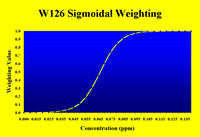 Some historical
perspective is important in understanding the background concerning
the events that led to the EPA's Administrator's decision on
revising the 8-hour ozone standard in October 2015. On March 12, 2008, the EPA Administrator
announced a decision on the human health and vegetation ozone
standards. At that time, EPA revised the 8-hour "primary"
ozone standard, designed to protect public health, to a level
of 0.075 parts per million (ppm). The previous standard, set
in 1997, was 0.08 ppm. EPA decided not to adopt the cumulative
exposure index as the vegetation standard (i.e., secondary ozone
standard). Although the EPA Administrator recommended the W126 index as the secondary ozone standard,
based on advice from the White
House (Washington
Post, April 8, 2008; Page D02), the EPA Administrator made the
secondary ozone standard the same as the primary 8-hour average
standard (0.075 ppm). On May 27, 2008, health and environmental
organizations filed a lawsuit arguing that the EPA failed to
protect public health and the environment when it issued in March
2008 new ozone standards. On March 10, 2009, the US EPA requested
that the Court vacate the existing briefing schedule and hold
the consolidated cases in abeyance. EPA requested the extension
to allow time for appropriate EPA officials that were appointed
by the new Administration to review the Ozone NAAQS Rule to determine
whether the standards established in the Ozone NAAQS Rule should
be maintained, modified, or otherwise reconsidered. After an
extensive review process, the Obama Administration decided to
not revise the 0.075 ppm standard that was set during the Bush
Administration. The reason provided was that the EPA would soon
begin a new review cycle of the science associated with surface
ozone and recommend whether the 0.075 ppm standard needed to
be revised. Some historical
perspective is important in understanding the background concerning
the events that led to the EPA's Administrator's decision on
revising the 8-hour ozone standard in October 2015. On March 12, 2008, the EPA Administrator
announced a decision on the human health and vegetation ozone
standards. At that time, EPA revised the 8-hour "primary"
ozone standard, designed to protect public health, to a level
of 0.075 parts per million (ppm). The previous standard, set
in 1997, was 0.08 ppm. EPA decided not to adopt the cumulative
exposure index as the vegetation standard (i.e., secondary ozone
standard). Although the EPA Administrator recommended the W126 index as the secondary ozone standard,
based on advice from the White
House (Washington
Post, April 8, 2008; Page D02), the EPA Administrator made the
secondary ozone standard the same as the primary 8-hour average
standard (0.075 ppm). On May 27, 2008, health and environmental
organizations filed a lawsuit arguing that the EPA failed to
protect public health and the environment when it issued in March
2008 new ozone standards. On March 10, 2009, the US EPA requested
that the Court vacate the existing briefing schedule and hold
the consolidated cases in abeyance. EPA requested the extension
to allow time for appropriate EPA officials that were appointed
by the new Administration to review the Ozone NAAQS Rule to determine
whether the standards established in the Ozone NAAQS Rule should
be maintained, modified, or otherwise reconsidered. After an
extensive review process, the Obama Administration decided to
not revise the 0.075 ppm standard that was set during the Bush
Administration. The reason provided was that the EPA would soon
begin a new review cycle of the science associated with surface
ozone and recommend whether the 0.075 ppm standard needed to
be revised.
- For several
years, A.S.L. & Associates has had an on-going effort to
better understand the range and frequency of occurrence of background
ozone levels that may not be affected by emission reduction strategies.
In a paper published
in May 2001, the research team consisting of Allen Lefohn, Samuel
Oltmans, Tom Dann, and Hanwant Singh discussed that background
ozone levels were higher and that the natural short-term variability
was more frequent and greater than previously believed. In our
2001 paper, we concluded that hourly
levels greater than or equal to 50 ppb occur more frequently
as a result from natural sources than previously believed. In 2006, the
US EPA defined Policy-Relevant Background
(PRB) for ozone as those concentrations that would occur in the
United States in the absence of anthropogenic emissions in continental
North America (i.e., the United States, Canada, and Mexico).
PRB concentrations (renamed by the EPA as North American Background
(NAB)) include contributions from (1) natural sources everywhere
in the world and (2) anthropogenic sources outside the United
States, Canada, and Mexico. In 2008, we published results, using
empirical data, confirming that at some locations in the US,
background ozone concentrations were greater than or equal to
50 ppb. In September 2009,
the National Research Council released the report, Global
Sources of Local Pollution. In the report, the Committee
stated that modeling and analysis supports the finding that background
was 20-40 ppb for the United States. Unfortunately, the NRC conclusion
did not agree with the peer-review literature using empirical
data that showed that hourly averaged background ozone concentrations
at times were greater than or equal to 50 ppb. Although spatially low-resolution
models were exercised at the time that indicated that conclusions
reached by Lefohn et al. (2001) were incorrect, our current
research and the results published by other research groups support
the conclusions reached by Lefohn et al. (2001) that backgrund
ozone concentrations are greater than or equal to 50 ppb at both
high- and low-elevation monitoring sites. An Internet-based slide presentation is available for purposes
of previewing our paper. Also please be sure to check out the
answer to our quiz that identifies the month
in which the highest 8-hour daily maximum concentration occurred
for some remote ozone monitoring sites. Additional information
on background ozone concentrations can be found in the Air Quality
Analyses section of our Table of Contents. In-depth discussions are
provided on this very important topic.
- The range of suggested
values for the W126 ozone vegetation standard is in part
historically based on the recommendations that were made at a
Workshop that took place in Raleigh, North Carolina in 1996.
To better understand what took place at this workshop, please
click here. The workshop's conclusions are very
interesting and are still relevant today (i.e., almost 30 years
later). Over the years, the EPA and CASAC have focused on an ozone standard
that accumulates over a 12-hour (8 am – 8 pm) exposure period
for a 3-month period providing greater weight to exposures at
higher ozone levels. Our analyses and peer-reviewed published
papers indicate that such a
secondary ozone standard, in its proposed form, might overestimate
vegetation effects. For information about such a standard, please click
here. You can learn
more about the subject of vegetation effects by visiting our
Table of Contents web page.
- Lefohn, Shadwick,
and Oltmans (2010) have statistically quantified in a paper published
in the peer-reviewed journal, Atmospheric Environment,
a site-by-site trending analysis for the period 1980-2008 and
1994-2008. Lefohn et al. (2010) point out that many ozone monitoring
sites show no statistical changes over time, as well as a small
number of sites show increases in trending. Please see the publications list for the citation.
As indicated above, Lefohn et al. (2010)
published their trending findings for surface ozone monitoring
sites across the United States. Using statistical trending on
a site-by-site basis of the (1) health-based annual 2nd highest
1-hour average concentration and annual 4th highest daily maximum
8-hour average concentration and (2) vegetation-based annual
seasonally corrected 24-hour W126 cumulative exposure index,
they investigated temporal and spatial statistically significant
changes that occurred in surface ozone in the United States for
the periods 1980-2008 and 1994-2008. For more information about
the Lefohn et al. (2010) and Lefohn et al. (2008) (for the period
1980-2005 and 1990-2005) findings, please click
here.
Since 1997, we have
been discussing the "piston effect" in the peer-reviewed
literature (see publications listing).
In 1997, we predicted that there would be a leveling off of improvements
in O3 concentrations as O3 emission precursors were reduced at
some monitoring sites Our prediction apparently has been verified
by the most current trends analysis provided by the EPA on its
website (https://www.epa.gov/air-trends/ozone-trends).
The "piston
effect", as described in the peer-review literature and
on this website, affects the ability
of the nation to attain the 8-hour ozone standard as lower and
lower 8-hour standards are established. As we discussed in our
original paper, the peak hourly average concentrations are reduced
much faster than the mid-level concentrations. This pattern is
discussed in our publication on trends in the EU, US, and China
(Lefohn et al., 2017-see publications
list). Clearly the "piston effect" heavily influences
the Nation's ability to attain an 8-hour ozone standard as standard
levels are reduced. We discuss more about the "piston effect"
and how it affects the attainability of the ozone standard in
our concerns web page.
- Over the past years, A.S.L. & Associates and its
consultants have commented on the strengths and weaknesses associated
with the mathematical and statistical methodologies used in epidemiological
studies to link exposure with human health effects. Many of the
statistical caveats raised in the EPA's PM and Ozone rulemaking
documents indicate a pattern of results that illustrate uncertainties
that have been problematic especially in the setting of the ozone
human health standard. Details about the epidemiological concerns
are discussed in our epidemiological
concerns web page.
- Sometimes science
and politics mixed together become science fiction. Such is the
case that occurred, when in September 2002, many newspapers across
the United States printed a story summarizing the report, Code
Red: America's Five Most Polluted National Parks, which described
The Great Smoky Mountains as the nation's most polluted national
park, with air quality rivaling that of Los Angeles. For the
period 1997-2001, the report suggests that the annual ozone exposure
was higher at Great Smoky Mountains National Park than at Los
Angeles, California. There is a serious technical problem associated
with the report and the report's conclusions are flawed. Please
read "The Rest of the Story."
- In 2000, Haywood County, NC experienced its 4th highest
8-hour
 ozone concentration at 0.085 ppm.
On May 1, a daily maximum 8-hour average concentration of 0.089
ppm was experienced. A detailed meteorological
analysis suggests
that stratospheric ozone played an important role in this ozone
episode. ozone concentration at 0.085 ppm.
On May 1, a daily maximum 8-hour average concentration of 0.089
ppm was experienced. A detailed meteorological
analysis suggests
that stratospheric ozone played an important role in this ozone
episode.
Home
Page | News |
Corporation | Maps
| Publications | Table
of Contents | Multimedia Center
Copyright ©
1995-2026 A.S.L. & Associates. All rights reserved.
Privacy Notice
|
|


